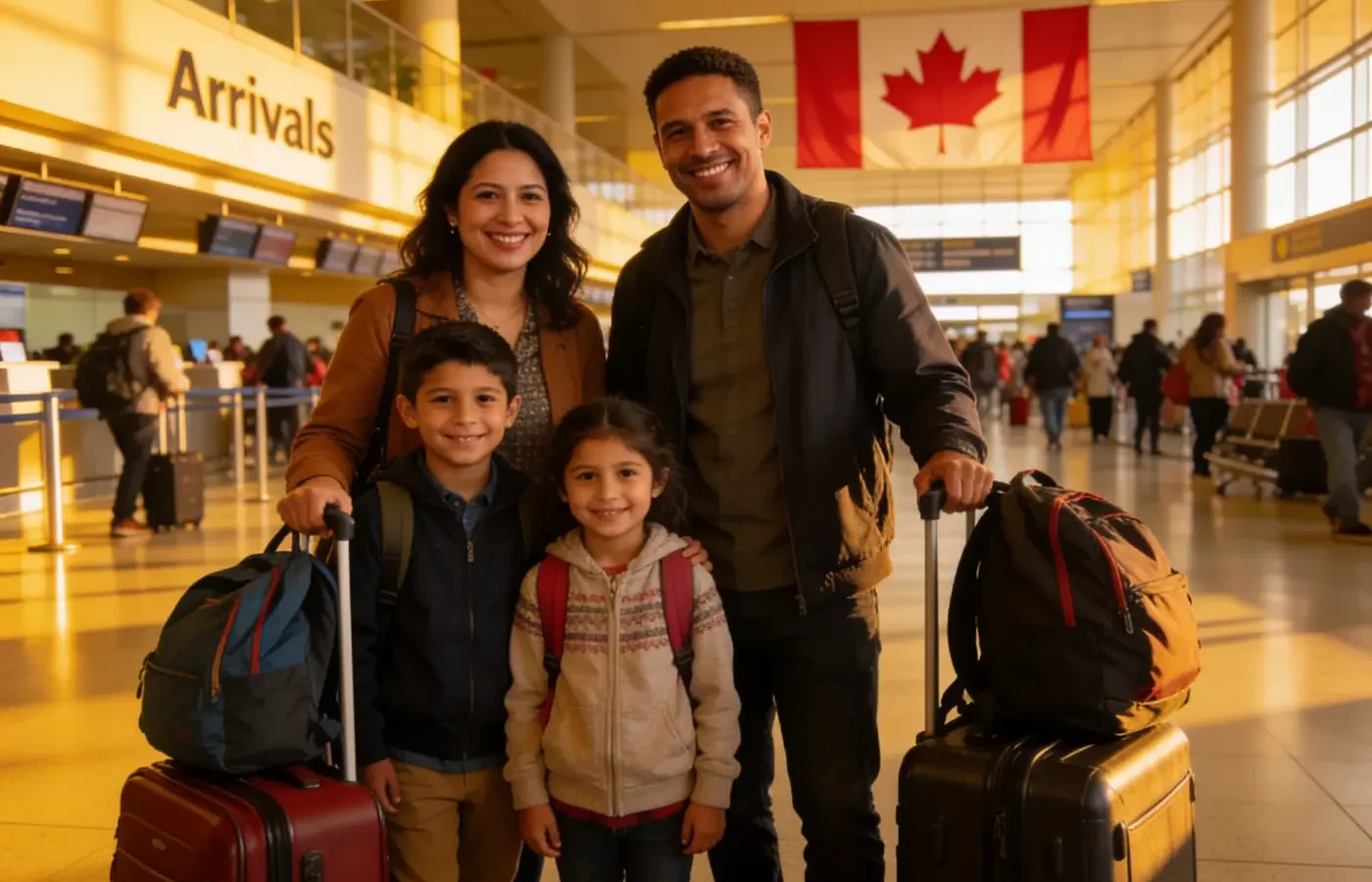
For many people, the ultimate goal is not just a permanent resident card but bringing their family to settle in Canada together. The good news is that skilled worker pathways allow you to include your spouse and dependent children in the same application.
However, correctly declaring family members is a step many people get wrong. This article explains who counts as a dependent, the difference between accompanying and non-accompanying family members, and the key documents and notes for bringing your family to Canada.
bringing your family to Canada — illustrative image.
Contents
Who counts as a dependent when bringing your family to Canada
When bringing your family to Canada under a skilled worker pathway, the principal applicant can include certain family members in the permanent residence application. The two most common groups are spouses and dependent children.
Regarding spouses, the federal immigration authority (Immigration, Refugees and Citizenship Canada, or IRCC) recognizes a legally married spouse, or a person living together as spouses (common-law partner) in a continuous relationship for the required length of time. What matters is that the relationship is genuine and can be proven.
Regarding children, a “dependent child” is generally understood as a child under the prescribed age threshold who does not have a spouse or common-law partner. In some cases, a child over the age threshold who is dependent due to a health condition may also be considered. You should check the exact definition and current age threshold on the official website of Immigration, Refugees and Citizenship Canada.
The whole family in one application
Under skilled worker pathways such as Express Entry, the principal applicant declares their spouse’s and children’s information within their own application. Once approved, accompanying family members receive permanent resident status at the same time. This is a major advantage: the family does not have to submit multiple separate applications and wait separately.
The application’s score can also be affected by the spouse, since the points system takes into account the accompanying spouse’s education, language and work experience. Declaring information fully and accurately is therefore not just a formality but has a direct impact on the chances of approval.
Accompanying and non-accompanying family members: a clear distinction
This is a concept that confuses many families. IRCC distinguishes between an “accompanying family member” and a “non-accompanying family member”.
An accompanying family member is included in the application and intends to move to Canada to settle at the same time. A non-accompanying family member is declared in the application but is not applying for permanent residence at that time, for example a child still studying in Vietnam or a spouse who temporarily does not wish to go.
Core principle: whether or not a family member is accompanying you, you must still declare them in the application. Omitting or misreporting a family member can lead to serious consequences, including the family member not being eligible for sponsorship later if they were not declared.
Why underreporting is dangerous
- The application may be considered to involve misrepresentation, affecting the principal applicant’s own permanent resident status.
- A family member who was not declared and screened from the start may later be ineligible to be sponsored by you.
- Adding a family member later is far more complicated than declaring them correctly from the start.
So even if you’re certain a family member will not go right away, you should still declare them as non-accompanying, along with documents proving the relationship.
Medical exams and background checks for every family member
One point that often comes as a surprise: all family members declared in the application must undergo a medical exam and a background check, including non-accompanying members. The purpose is to ensure everyone involved is fully screened.
The process and timing for submitting medical exam results can change depending on the policy in effect at the time. In recent years, some categories have required medical exam results to be submitted right at the time of application rather than waiting until later. You should check the current requirements to prepare at the right time and avoid delays.
The medical exam must be conducted at a facility designated by IRCC, not any hospital of your choosing. Schedule it early for the whole family to keep everyone’s timeline in sync.
Documents proving family relationships
When bringing your family to Canada, proving the relationship is mandatory for every declared family member, whether accompanying or not. Documents must be translated by a certified translator if the originals are not in English or French.
| Thành viên | Common supporting documents |
|---|---|
| Spouse (married) | Marriage certificate; joint photos, evidence of shared life |
| Common-law partner | Evidence of continuous cohabitation: shared lease, joint bills, joint accounts |
| Dependent child | Birth certificate; documents showing dependent status if needed |
In addition to the table above, IRCC usually requires additional family information to be declared through a separate form, listing all family members in full. Fill it in consistently across forms to avoid data discrepancies that could bring extra scrutiny to your application.
Note on language and translation
Vietnamese documents need to be translated into English or French, with a certified translator’s confirmation as required. Names on documents should be consistent; if there are differences due to transliteration or diacritics, you should prepare an explanatory statement to avoid identity questions.
After the whole family arrives in Canada
Being approved is only the starting point. Once the whole family settles in Canada, there is a series of things to do early to stabilize life and unlock benefits.
- Register each family member for provincial health insurance as soon as they are eligible.
- Apply for an identification number to work and file taxes; open a bank account for the family.
- Enroll children in public school based on your residential address.
- Look into family benefits tied to tax filing.
These steps are closely linked. For instance, the family’s tax filing affects eligibility for child benefits, so you should also read more about income tax in Canada so you don’t miss out on benefits. On health, the article health insurance in Canada for newcomers will help you understand wait times and how to register.
Children’s schooling and family expenses
When bringing children over, getting them into school is a priority. Canada’s public school system admits students based on residency, and there is a lot of support for newly arrived students. You can refer to the article sending children to school in Canada to get a sense of the enrollment process and school levels.
A larger family means higher living costs. Drawing up a realistic budget before you go helps avoid being caught off guard. The article cost of living in Canada provides a breakdown by spending category so you can budget for the whole family.
Common mistakes to avoid
In practice, there are a few recurring mistakes that delay or add risk to the process of bringing your family to Canada.
- Not declaring a family member because you think “they’re not coming, so no need to declare” — this is a misconception with major potential risk.
- Letting a child cross the dependent age threshold while the application is in process, making the child no longer eligible to accompany you.
- Preparing sloppy documents proving the relationship, especially for common-law partnerships.
- Delaying the medical exam for non-accompanying members, which holds up the entire application.
The general advice is to declare honestly, fully and early. For complex cases involving marital status or children from a previous relationship, consulting a qualified professional will save time and avoid risk down the road.
What an accompanying spouse can do in Canada
A very practical question when bringing your family to Canada is what an accompanying spouse can do. This is a point that makes skilled worker pathways more attractive than many other routes.
When the whole family receives permanent resident status together, the accompanying spouse is also a permanent resident, so in principle they are free to work for most employers, study, and access many public services just like the principal applicant. This is a major difference from some temporary status categories, where an accompanying person’s work rights are restricted.
In practice, both spouses being able to work helps the family stabilize financially much faster. However, if the spouse’s profession is a licensed one, they still have to go through the recognition process and obtain a license like any other newcomer before practicing officially.
So when planning, you should factor in both spouses’ career paths, not just the principal applicant’s. It is normal for one spouse to temporarily work in a different job while obtaining a license during the early settlement period.
Accompanying children: schooling and integration rights
For families with children, being able to bring children along and have them fully educated is often the biggest motivation. When a child is an accompanying permanent resident, they are entitled to attend public school based on residency, just like native-born children.
The public school system accepts newly arrived students and usually has language support programs for children who are not yet fluent. This helps your child integrate gradually without being left behind. The level of support and how classes are assigned can vary by location.
One point to note is the child’s age at the time the application is assessed. Since the definition of a dependent child is tied to an age threshold, a long processing time can cause a child to age out. This is an important reason to prepare and submit the application early, while closely monitoring processing progress.
| Accompanying member | Main rights as a permanent resident |
|---|---|
| Spouse | Can work, study, access public services; licensed professions still require obtaining a license |
| Dependent child | Attends public school based on residency; language support if needed |
Costs and financial preparation for the whole family
Bringing the whole family means needing more thorough financial preparation than going alone. There are two cost categories to plan for: costs during the application process and costs of settling in afterward.
During the application process, besides processing fees for each family member, the family will also incur costs for medical exams, document translation, and sometimes proof of financial capacity to show the family can support itself in the early period. These fees and requirements change over time, so you need to check the current rates from official sources.
After arrival, costs for a larger family increase significantly: bigger housing, food, transportation, school supplies for children. Drawing up a realistic budget for the first few months, when no one may have found stable work yet, is very important to avoid financial pressure.
- Set aside enough living expenses for the whole family during the initial period without stable income.
- Calculate rent appropriate to the number of family members and the place of settlement.
- Prepare a budget for children: school supplies, sometimes extracurricular activities.
- Set aside a contingency fund for unplanned situations.
Summary
Bringing your family to Canada under a skilled worker pathway allows a spouse and dependent children to obtain permanent residence together in one application, but requires honestly declaring every family member, preparing documents proving the relationship, and completing medical exams for everyone. Depending on each family’s circumstances regarding children’s age, marital status and whether family members will accompany you, you should check current regulations from official sources before making decisions.
References
This article is compiled from government sources. Immigration regulations and figures may change over time; you should check current information on the official website before making a decision.
My spouse doesn’t want to come right away — do I still need to declare them in the application?
Yes. You still must declare them as a non-accompanying family member, along with documents proving the relationship. Omitting a family member can cause the application to be considered misrepresentation and affect sponsorship later.
My child is close to the dependent age limit — what’s the risk?
If the child crosses the dependent age threshold while the application is being processed, they may no longer be eligible to accompany you. So you should prepare and submit the application early, while monitoring the current definition of a dependent child.
Does a non-accompanying family member also need a medical exam?
Yes. All family members declared in the application, including non-accompanying members, must undergo a medical exam and background check at a facility designated by the immigration authority.
How do I prove a common-law partnership?
You need evidence of continuous cohabitation for the required length of time, such as a joint lease, shared utility bills, joint accounts and photos of life together. The relationship must be genuine and continuous.
What should we do first once the whole family arrives?
Prioritize registering for provincial health insurance, applying for an identification number to work and file taxes, opening a bank account, and enrolling children in school based on your residential address. Filing taxes also unlocks family benefits.