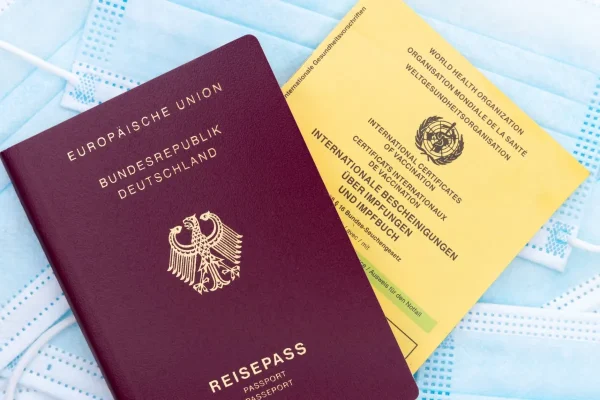
Skilled migration to Germany is opening its doors wider to highly qualified workers, and applying for the EU Blue Card is the fastest, most stable path for those with a university degree. This is a residence permit for professionals with a high level of education, tied to an employment contract that meets the salary threshold set in Germany. In this guide, the My Second World team will walk through the conditions, documents and process step by step so you can clearly picture your own path.
What is the EU Blue Card and why choose it
The EU Blue Card is a time-limited European Union residence permit, applied in Germany to non-EU workers who hold a university degree and a job matching their qualifications. It is not a tourist or general labor visa, but a channel reserved for skilled professionals.
The appeal of this card lies in its shortened path to permanent settlement. EU Blue Card holders can apply for a permanent settlement permit (Niederlassungserlaubnis) much earlier than under other categories, provided they meet the German language requirement.
In addition, the card allows spouses and children to join for family reunification in Germany. The spouse is permitted to work immediately without needing to prove a high level of German proficiency. This is why many young families prioritize this option when considering skilled migration.
Core requirements for applying for the EU Blue Card
To apply for the EU Blue Card, you must simultaneously meet three groups of requirements: qualifications, an employment contract, and salary. Missing any one of the three will make the application ineligible for review.
First, regarding qualifications, you must hold a university degree recognized in Germany, or an equivalent foreign degree. For certain IT fields, sufficiently long professional experience may also be accepted in place of a formal degree, subject to current regulations.
Second, you must have a specific employment contract or job offer letter from a company in Germany. That job must match the professional qualification you studied for. This is a major difference from the Chancenkarte, which allows you to go to Germany to look for work first.
Third, the salary in the contract must reach the minimum threshold set by law each year. This threshold is lowered for shortage occupations (such as IT, healthcare, engineering, mathematics) and for recent graduates within 3 years of graduation. The specific salary threshold changes annually, so you need to check the latest figure at an official source.
Step 1: Verify and have your degree recognized
Before submitting any documents, the first task is to verify whether your university degree is recognized in Germany. This is a foundational step, since the entire application depends on this result.
You can look up your school and degree in the database of Anabin, the system for recognizing foreign degrees, managed by the Standing Conference of the Ministers of Education and Cultural Affairs of the German states (KMK). The lookup result will tell you whether your degree is fully recognized, partially recognized, or not recognized.
If your degree is not listed in Anabin or requires official confirmation, you can request an equivalency assessment document called a Statement of Comparability from the competent authority. This process can take several weeks, so it should be started as early as possible.
Step 2: Find and sign an employment contract that meets the salary threshold
Once your degree recognition is confirmed, the next step is to secure a suitable job in Germany. This is usually the most time-consuming stage for Vietnamese workers.
The contract must clearly state the position, job description, term, and annual gross salary. This salary is the decisive factor: if it does not reach the legal threshold, the EU Blue Card application will be rejected even if the qualifications and experience are strong.
When negotiating the contract, you should note the following points:
- The annual gross (brutto) salary must be equal to or higher than the threshold set for the year of application.
- The job position must correspond to the field studied or the area of expertise.
- Prioritize shortage occupations to benefit from a lower salary threshold, if it matches your capability.
- The contract should have a sufficiently long term, ideally 6 months or more.
Some occupations classified as shortage occupations benefit from a preferential salary threshold and a more favorable review process. However, for these occupations, the Federal Employment Agency may take part in the assessment to confirm that the working conditions are equivalent to those for local workers.
Step 3: Prepare a complete set of documents
Once you have the contract and degree recognition, you begin compiling your documents. A complete, well-organized set of documents will significantly shorten the processing time.
The core documents usually include:
- A valid passport and biometric-standard passport photos.
- A fully completed visa or residence permit application form.
- University degree with transcript, notarized and translated into German or English.
- Anabin lookup result or a degree equivalency assessment document.
- Employment contract or job offer letter stating the annual gross salary.
- Job description provided by the employer.
- Proof of valid health insurance for the initial period in Germany.
- A CV formatted to the European standard.
All documents in Vietnamese must be notarized and translated. Some diplomatic missions require consular legalization for degrees, so you should check the specific list required by the consulate before submitting.
Step 4: Submit the visa application at the German Embassy
If you are in Vietnam, the application is submitted at Germany’s diplomatic representative office. You need to book an appointment in advance, since visa interview slots are often booked out for weeks.
At the appointment, the officer will check the original documents, collect your application, and take your fingerprints. You apply for a national visa (long-stay Type D visa) for employment purposes, to be converted into the EU Blue Card after arriving in Germany.
Detailed information on requirements, the document checklist and the process is published on the portal Make it in Germany, the official information portal of the German Government for foreign workers. You should cross-check your document checklist against this portal right before submitting, as regulations may be updated.
As for the visa fee, you pay according to the current fee schedule of the diplomatic mission, which is publicly posted on the consulate’s website. Our team recommends not trusting unverified fee figures found online, and relying only on official sources.
Step 5: Arrive in Germany, register your residence and receive the card
After being granted the Type D visa, you enter Germany and complete the final procedures to receive the official EU Blue Card. This stage takes place locally in the area where you live.
The basic sequence includes the following steps:
- Register your residence address (Anmeldung) at the local administrative office within the prescribed period after arrival.
- Open a bank account and finalize a health insurance contract in Germany.
- Book an appointment and submit the EU Blue Card application at the local Immigration Office (Ausländerbehörde).
- Receive the electronic residence card once the application is approved.
The card is usually issued with a validity period tied to the employment contract and is renewed as the contract continues. Throughout this period, you should maintain full social insurance contributions, as this serves as the basis for permanent settlement review later on.
The path from the EU Blue Card to permanent settlement
One of the reasons many people choose to apply for the EU Blue Card is its markedly shorter path to permanent settlement. Germany allows cardholders to apply for a permanent settlement permit early, provided they meet the German language requirement and have paid into pension insurance for a sufficient period.
If you reach a basic level of German proficiency, the waiting period for settlement is shortened even further. Therefore, from the moment you receive the card, learning German alongside your job is a worthwhile investment for your long-term goal.
In addition, the time spent holding the EU Blue Card counts toward the requirements for German citizenship applications later. The card is therefore not just a work permit but also the starting point for the whole journey of integration and settling the family in Germany.
Notes to keep your application from being delayed
Most EU Blue Card applications are delayed not due to a lack of qualification, but because the documents were not properly prepared. The following notes will help you avoid common mistakes.
First, verify your degree on Anabin before job hunting, to make sure your qualification is eligible. Many people spend months job hunting only to later discover their degree is not fully recognized.
Next, carefully compare the salary in the contract against the threshold for the year of application. A contract that falls just a few hundred euros below the threshold is enough to get the application rejected. In addition, the notarized translation must match the original exactly, since even a small discrepancy in a name or date can get the application returned.
Finally, you should keep all receipts and copies of the submitted application. When the authority requests additional documents, having copies on hand will help you respond quickly and avoid starting over from scratch.
Summary
Applying for the EU Blue Card in Germany is a clear path for workers with a university degree, comprising five main steps: verifying your degree via Anabin, finding a contract that meets the salary threshold, preparing your documents, submitting the visa application at the diplomatic mission, and completing residence registration upon arrival in Germany. The key always lies in three factors: a recognized degree, a job matching your expertise, and a salary reaching the legal threshold for the year of application.
Next steps: look up your degree on Anabin and review your career direction, especially if you belong to a shortage occupation eligible for a preferential salary threshold. At the same time, starting to learn German early will help shorten your path to permanent settlement later on.
If you need a personalized roadmap tailored to your field and profile, the immigration consulting team at My Second World is ready to accompany you through every step of preparation.