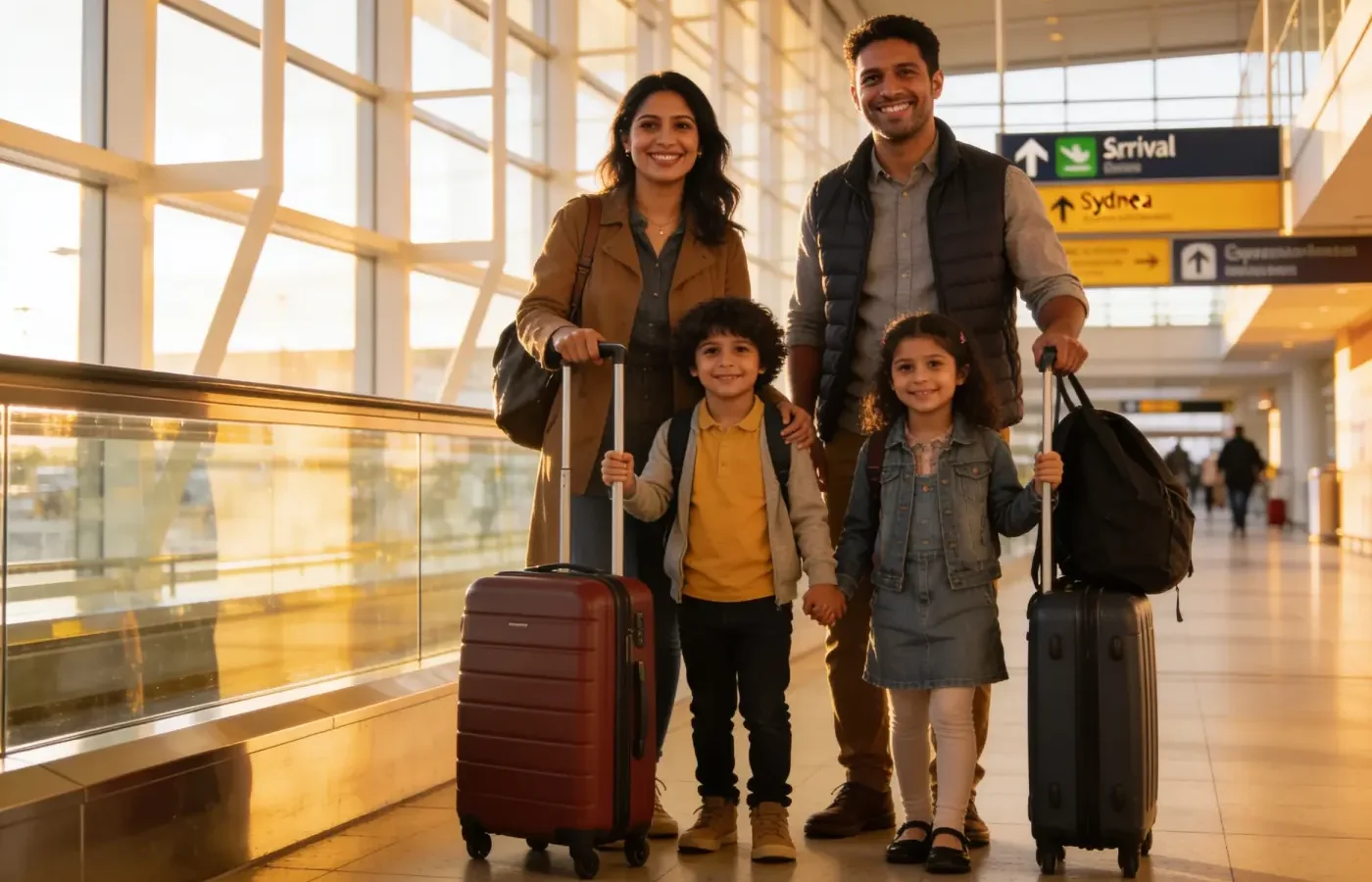
Bringing family to Australia is a legitimate wish for most skilled migrants. The good news is that Australia’s immigration system allows you to include your spouse and children in the same application, as long as they meet the family member criteria. Understanding the rules correctly from the start helps the whole family move smoothly together.
bringing family to Australia — illustrative image.
Contents
The concept of “family member” in a visa application
Before discussing procedures, you need to understand clearly who counts as a family member in an Australian visa application. This concept has a specific legal definition; not every close relative can automatically be included.
The group usually eligible to be included in the application comprises:
- A legal spouse, or a recognized de facto partner
- Dependent children, including biological children and stepchildren of the spouse
- In some cases, other dependents who meet strict criteria
In a skilled migration application, the primary applicant is the one whose skills are assessed and who meets the visa conditions. The spouse and children usually participate as secondary applicants. This means they are granted a visa based on their relationship with the primary applicant, without needing to meet the skills requirements themselves.
Including a spouse in the application
When you want to bring family to Australia, a spouse is the most commonly added family member. Australia recognizes both legal marriage and de facto relationships, including same-sex couples, as long as the relationship can be proven to be genuine and ongoing.
To prove the relationship, immigration authorities usually consider several aspects: shared finances, shared living arrangements, long-term commitment, and social/family recognition of the relationship. You should prepare diverse evidence such as joint bank accounts, a lease agreement in both names, photos together over time, and letters of support from acquaintances.
If the relationship began after the primary applicant already holds a visa, bringing the spouse over usually then follows a different pathway, such as a partner visa. This is a separate visa category with its own independent process and conditions. You can refer to official information about the partner visa on the website of Department of Home Affairs.
Including dependent children
Children can be included in the application if they meet the definition of a dependent child. The general principle is based on age and degree of financial dependence:
- Children under a certain age are automatically considered dependent
- Children past that age but still studying and financially dependent on their parents may still be included, up to a higher age limit
- Children who cannot support themselves due to physical or intellectual limitations may be considered regardless of age
A point to note: a stepchild of the spouse can also be included, but custody-related legal matters must be resolved, especially when the other biological parent is not accompanying the family. Immigration authorities usually require valid consent to avoid disputes.
An important principle many families overlook: you should generally declare and include children in the application right from the lodgment stage. After the visa has been granted, adding a family member can be much more difficult or may require going through a different visa category. So make a complete list of family members from the very start.
Benefits for family members when moving to Australia
When included in a skilled visa application and the visa is granted, the spouse and children usually receive residency benefits similar to the primary applicant. Depending on the visa type, these family members may be able to:
- Live permanently in Australia together with the primary applicant
- Work in Australia, with some visas allowing the spouse to work full-time
- Enroll children in the education system, with tuition fees depending on the visa type
- Access the public health system to an extent depending on visa status
Because education and health benefits depend on the specific visa type, you should confirm the details carefully before planning. To understand the school system and study costs for children, read the article sending children to school in Australia: the system and costs. On health, the article health insurance in Australia for new residents will help you picture your Medicare entitlements.
Cost implications of bringing family to Australia
Adding more family members to the application increases the total application cost, as each secondary applicant usually incurs a separate fee. The fee for an adult secondary applicant is usually higher than for a child, and these figures are adjusted periodically by immigration authorities. You should check the current fees at official sources rather than estimating.
In addition to the visa fee, there are other costs to plan for:
- Health examinations and police clearance checks for each member
- Certified translation of documents such as birth certificates and marriage certificates
- Initial settlement costs for the whole family
Since the budget for a whole household is much larger than for one person alone, you should draw up an overall financial plan. The article cost of living in Australia provides a perspective on monthly budgeting to help the whole family prepare.
Arranging tax and finances for the whole family
When both spouses work in Australia, each needs their own TFN and has an independent tax filing obligation. Understanding the tax mechanism early helps the family avoid incorrect withholding and plan income and spending sensibly. You can refer to the article income tax in Australia: TFN and what newcomers need to know to prepare for both spouses.
Some families also consider the order in which to move: the primary applicant goes first to settle into a job and housing, then the other family member follows later. This approach has financial advantages but requires weighing the time apart and the children’s schooling. There is no absolute right choice; what matters is what suits each family’s circumstances.
Preparing documents for family members
Each member included in the application needs their own set of documents, so preparing early and systematically helps avoid delays. Unlike a single-applicant file, a family application requires synchronization across multiple sets of documents.
Documents commonly required for family members include:
- Birth certificates for each child, with a recognized English translation
- Marriage certificate or evidence of a de facto relationship
- Valid passport for each member
- Health examination results as required for each person
- Police clearance for members who have reached the required age
Names and dates on documents need to be consistent across the passport, birth certificate and other documents. Vietnamese applicants often run into difficulty when the name on old documents differs from the current passport, or the date of birth is recorded inconsistently. If there are discrepancies, you should prepare explanatory or corrective documents before submitting, to avoid immigration authorities flagging it and requesting further information.
Translations of Vietnamese documents must be done by a recognized translation provider. A translation that does not meet the standard can delay the entire application, even if the original content is completely valid.
Health examinations and character requirements
Most Australian visa applications require each family member to meet health and character standards. This requirement applies to secondary applicants as well, not just the primary applicant.
For health, members usually need to be examined at a designated medical facility. The purpose is to ensure that health conditions do not place an excessive burden on Australia’s public health system. For families with a member who has a chronic illness, this is a point to research carefully early on, as it can affect the outcome of the application.
For character, members who have reached a certain age usually need to provide police clearance from places where they have lived long enough. You should start applying for these documents early, as the process in some places takes time. One member’s delay in obtaining documents can hold up the entire family’s application.
Settling in for the whole family in Australia
After the visa is granted, the next challenge is settling in for every family member. Bringing family to Australia does not end with visa approval — it is also an entire integration process.
Things that usually need to be arranged in the early stage include:
- Finding housing suitable for the family size and close to schools
- Enrolling children in school and getting familiar with the education system
- Setting up health benefits for each member
- Opening a bank account and arranging the household’s shared finances
- Learning about transportation and the surrounding community
Each task takes time, so many families feel overwhelmed in the first few months. Making a priority list and working through it sequentially helps reduce the pressure. Support from the local Vietnamese community is also very valuable; you can refer to the article the Vietnamese community in Australia to find an initial support network for the whole family.
Common mistakes when bringing family
In practice, a few recurring mistakes cause family applications to be delayed or complicated:
- Not declaring children from the start, then trying to add them after the visa has already been granted
- Providing weak evidence of a spousal relationship, lacking multi-faceted proof
- Overlooking custody issues when bringing a stepchild
- Underestimating the total cost for the whole household
- Not checking the spouse’s work rights under the specific visa type
Since each skilled visa type has its own rules regarding family members, you should check directly against the conditions of the visa you are pursuing. Preparing a complete family application from the start is always less risky than having to fix it later.
Summary
Bringing family to Australia under a skilled migration pathway is feasible and common, as long as the spouse and children meet the definition of family member and are fully declared from the start of the application. Depending on your goals, your children’s ages and your family’s budget, you should determine the list of family members early, prepare solid relationship evidence, and check the current fees and entitlements at official sources before submitting.
References
- Department of Home Affairs – Partner visa FAQs
- Department of Home Affairs – Subclass 309 Partner (Provisional) visa
This article is compiled from government sources. Immigration regulations and figures may change over time; you should check current information on the official website before making a decision.
Can I include my spouse in a skilled visa application?
Yes. A legal spouse or recognized de facto partner can participate as a secondary applicant, based on the relationship with the primary applicant, without needing to meet the skills requirements themselves.
Can a child over 18 still be brought to Australia with their parents?
Possibly, if the child is still studying and financially dependent on the parents, up to a higher age limit. A child who cannot support themselves due to physical or intellectual limitations may be considered separately.
What if I want to add a child after the visa has already been granted?
This is usually more difficult and may require going through a different visa category. So you should declare and include children in the application from the initial lodgment stage.
Can my spouse work in Australia?
It depends on the visa type. Many skilled visas allow the spouse to work, with some allowing full-time work. You should check the work rights under the specific visa you are pursuing.
Does bringing a stepchild require any special procedure?
Yes. You need to resolve custody issues, usually requiring valid consent from the other biological parent if they are not accompanying the family, to avoid legal disputes.